A Futuristic Debate Now Very Real: Why the World Is Struggling to Regulate Killer Robots
Envoys from 128 nations gathered in Geneva to weigh legally binding rules on AI-powered weapons that can kill without human input, but major arms producers remain opposed.
By Samuel Ellis ·
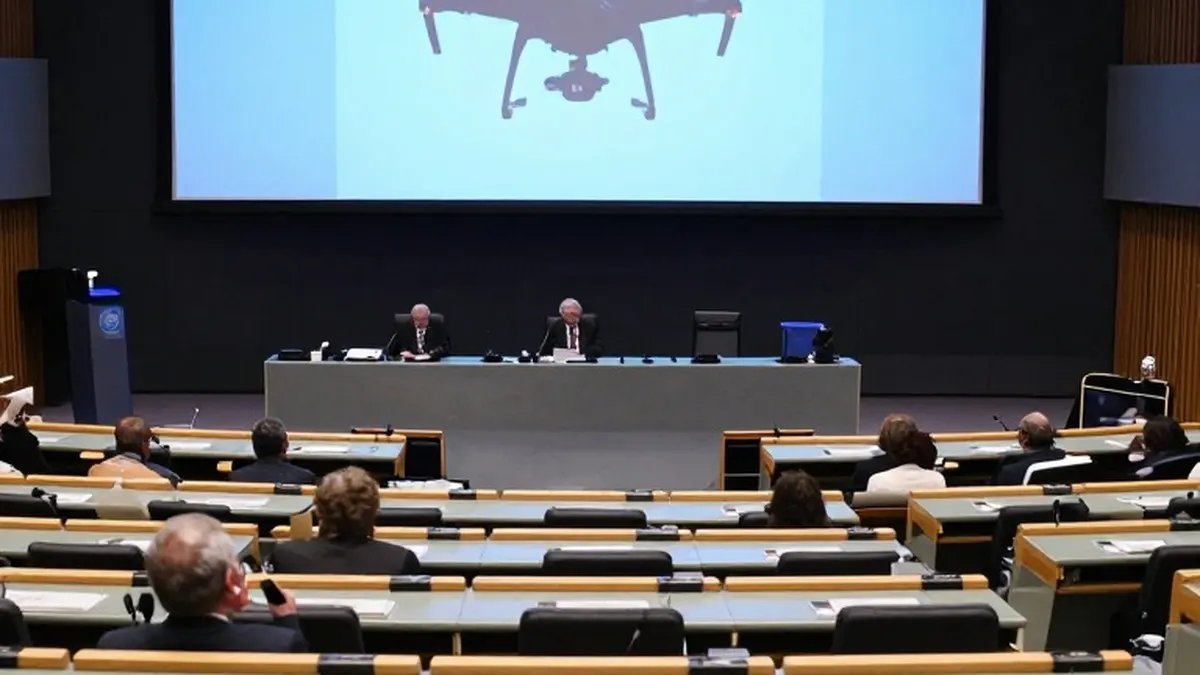
Government representatives from 128 countries convened in Geneva on Monday to determine whether to open negotiations on legally binding rules governing autonomous weapon systems, machines capable of killing without any human involvement. The talks take place under the unwieldy banner of the Review Conference for the UN's Convention on Certain Conventional Weapons, known as the CCW.
The question is far from theoretical. Over Ukraine, both Moscow and Kyiv have deployed lethal drones fitted with AI-powered guidance that lets them find and strike pre-programmed targets even after losing contact with a human operator. The escalation logic of war drives the trend: when one side builds signal jammers to knock attack drones off course, the other builds drones that no longer need a signal at all.
Both Russia and Ukraine are believed to be testing drones that go further still, selecting targets themselves rather than merely locking onto ones chosen by humans. New York Times reporting suggests the first fully autonomous drone to take human life may already have flown: Ukrainian forensic investigators believe six Russian drones that struck a petrol station in Zaporizhzhia in September, killing three people, were guided entirely by AI.
Vincent Boulanin, a senior researcher and director of the Governance and Artificial Intelligence Programme at the Swedish International Peace Research Institute, told FRANCE 24 that autonomous weapons have been debated within the CCW for more than a decade. The core concern, he said, is accountability: "States eventually agree on the fact that, ultimately, humans, or the commanders, are the ones responsible for making decisions under international law, but the question is, how do the autonomous features affect their ability to see that their usage will be lawful."
Boulanin noted that autonomy in weapons is not new. States have built autonomous systems for defensive purposes for decades, relying on automated processes in time-critical situations such as intercepting incoming missiles. Those uses were broadly accepted because they were narrowly constrained, targeting projectiles or large military objects.
What has unsettled observers in Ukraine, he said, is the shift to offensive use cases. Drones there remain largely remotely piloted, but because communications are frequently denied, both sides increasingly depend on automated targeting to complete missions, an approach known as "last-mile" targeting. "What used to be considered a futuristic debate is now something that is very tangible and real," he said, citing reports that such systems have been used against human targets.
On precedents, Boulanin pointed to the 1995 Protocol on Blinding Laser Weapons, which banned a technology before it was ever fielded, and to anti-personnel landmines, which states eventually agreed caused unnecessary suffering. But he cautioned that autonomous weapons are far harder to regulate because they take so many forms, from tunnel warfare against militant groups to potential naval conflict between the United States and China. Historically, he added, progress followed documented evidence of humanitarian harm combined with political will for consensus, conditions he described as very difficult at present.
Resistance from major weapons-producing states is a central obstacle. Boulanin said Russia, the United States and to some extent Israel have opposed a binding treaty from the start. Washington was once open to guidance documents clarifying lawful use, but that stance hardened under the Trump administration, which now resists any progress beyond existing law. He attributed the opposition to strategic competition with China and, in Israel's case, its war against Hamas: states do not trust adversaries to abide by new rules and want maximum room to manoeuvre.
The conference is expected to be tense. While most member states support binding regulation in principle, the CCW requires all decisions to be reached by consensus, giving holdouts an effective veto. Whether the gathering produces anything beyond another round of discussion may determine if the 1979 IBM warning Boulanin's field often cites, that a computer must never make a management decision, survives into the age of autonomous war.