Four Firefighters Killed as Winds Overtake Remote Colorado Crew
A federal report cites aggressive suppression tactics, understaffing, and communication failures in the June deaths.
By Samuel Ellis ·
Four wildland firefighters lost their lives in June when strong winds pushed flames through a remote area of western Colorado, according to a federal investigation released this week. The U.S. Department of the Interior identified a combination of unexpected fire behavior, chronic understaffing, and a new policy focused on rapid fire suppression as the primary contributors to the tragedy.
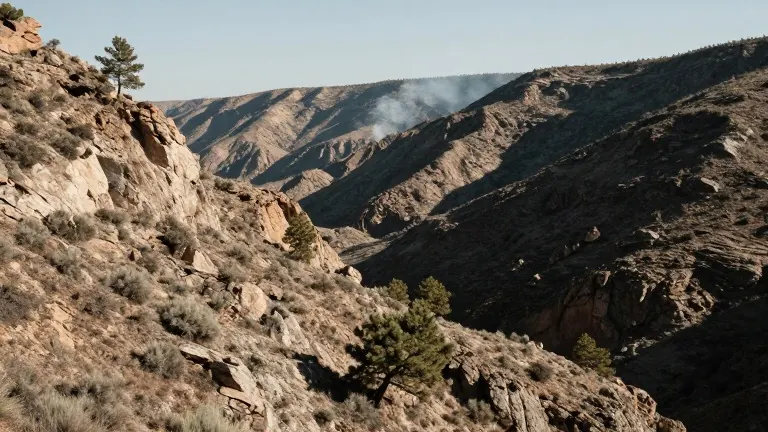
The incident involved the Knowles fire, which merged with other blazes to form the Snyder Fire along the border of Colorado and Utah. Members of the Rifle Helitack crew from the U.S. Forest Service and the U.S. Wildland Fire Service were dropped into the wilderness to construct a fire line. As they worked, wind conditions intensified, driving the fire over their position and trapping them.
The report notes that decisions to fight the fire aggressively were driven by a desire to limit the spread of cheatgrass and protect sage-grouse habitat near a downwind community. This strategy created an organizational posture to suppress new starts while they were small. The policy led to the insertion of helitack firefighters onto small wilderness starts despite a forecast of extreme fire weather.
Emily Barker, Nick Hutcherson, and Sydney Watson died at the scene on June 27. Nathan Matthews suffered burn injuries and died on July 24. A fifth member of the team was burned but survived. The firefighters were working in the Black Ridge Canyon Wilderness, a region experiencing extreme drought.
Ron and Lisa Hutcherson, parents of Nick Hutcherson, stated that the crew should not have been positioned ahead of the fire given the forecasted dangerous winds. They believe the deaths were preventable due to a failure of leadership and oversight. Ron Hutcherson said in an email that understanding how the fire reached their son did not explain why he was still there. He asked who was responsible for bringing the firefighters home while time remained.
Lisa Hutcherson added that her son depended on officials to track the fire and make safety decisions. The family met with investigators in Grand Junction on October 26 for a three-hour readout. The officials described failures in lookouts, communications, escape routes, and safety zones. An aging mobile radio system and software crashes compromised official channels, forcing some firefighters to rely on cellphones.
The investigation detailed how dispatchers managed up to 16 active aircraft, three emerging incidents, and multiple new starts simultaneously. This workload caused severe cognitive task saturation. Radio congestion prevented dispatchers from transmitting a mandatory scheduled fire weather forecast. Incident commanders on the Snyder and Jones fires lacked clear information about the location of firefighters on the Knowles and Gore fires.
A large fire observed eight miles west of the crew ran across complex terrain in less than three hours, reaching the five firefighters. They deployed fire shelters because a helicopter could not reach them in time. The report found that no operational role was assigned to continuously map personnel locations against the fires' trajectories, so overhead command did not recognize the crew was in the fire's path.
Timothy Ingalsbee, executive director of the nonprofit Firefighters United for Safety, Ethics and Ecology, attributed the problem to the administration's full-suppression policy. He described the tactic of aggressively attacking all fires as obsolete and unsustainable. Ingalsbee stated that the policy pushed crews nationwide to take unreasonable risks, and this specific team paid the ultimate price for that strategy.
More News · National news · Report a business · Got a Story?