Square Suspend Verified Account Without Explanation
A marketing firm provided all necessary documents and valid contracts, yet Square froze its funds and denied its appeal after missing its own deadline.
By Samuel Ellis ·
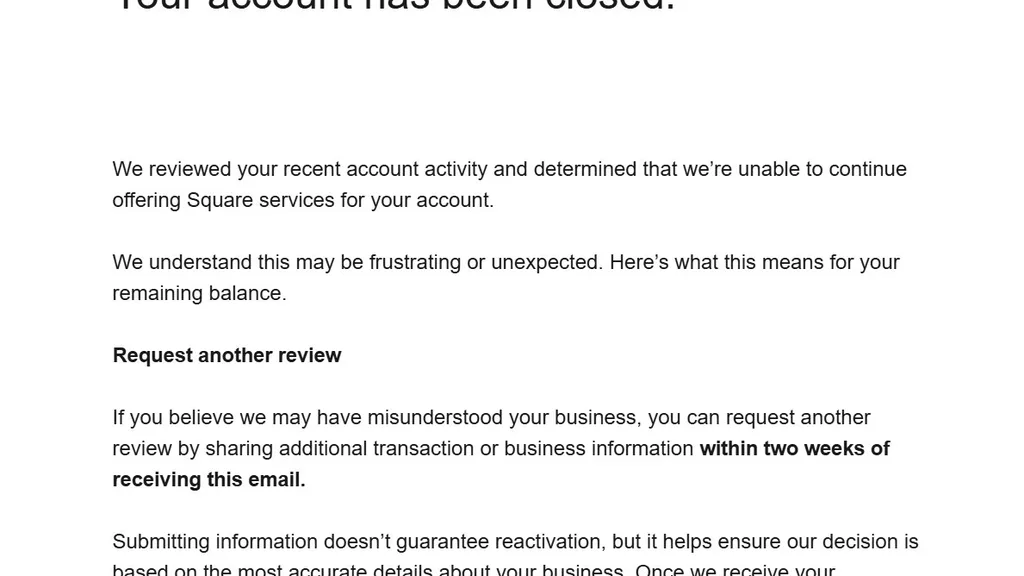
A small business that helps other companies with marketing and search engine optimization did everything right. It operated online and provided Square with every required document to verify its identity. The firm submitted its ID, linked a valid bank account, and provided the Employer Identification Number document straight from the IRS. It connected the bank account to the Square platform using third party software. It produced the Limited Liability Company formation documents. It held a valid contract with the client for the full sum of the money in question.
And Square suspended the account anyway.
The suspension was not because the business was missing a document. It was not because the bank account failed verification. The IRS did not say the EIN was fake. Square doubled down on a rule that did not exist. The rule was not even a listed reason for suspension. The business did not break the rule. The rule was not in the list. But the machine had made its decision, and the machine does not take questions.
The business appealed. Square promised a response in 10 days. It took two weeks. When the response finally arrived, it was a denial. There was no explanation. There was no reason. There was no human being to call, no office to walk into, and no face to look at while they told you that your money and your business were no longer welcome.
Just a denial. From a machine.
You gave them your identity. You gave them your tax documents. You gave them your bank account. You gave them the contract proving the money was real and the client was real. In return, you got a suspension with no reason and an appeal with no explanation.
This situation should make every small business owner in the country angry. The reason is written in Square's own contract, in their own words, on their own website.
Square's General Terms of Service, Section 12, state that the company may terminate these General Terms or any Additional Terms, or suspend or terminate your Square Account or your access to any Service, at any time for any reason. At any time. For any reason. The reason is optional.
Section 13, titled Effect of Termination, says that Square will not be liable to you or any third party for compensation, reimbursement, or damages for any termination or suspension of the Services. They can take your account, hold your money, and break your business, and they will not be liable.
Their Payment Terms, Section 12, say that Square may defer payout or restrict access to your Proceeds, temporarily or indefinitely. Temporarily or indefinitely. Your money, your revenue, the money your client already paid, sits in a company's account while a machine decides your fate.
And Section 14, the Reserve for Holding Funds, says that Square may require a Reserve for any reason related to your use of the Services. The Reserve will be in an amount as reasonably determined by us. Reasonably determined by us. Not by a bank. Not by a regulator. Not by a judge. By us.
Here is the most surprising part of the whole story. Square's Payment Terms, Section 1, open with a confession: We are not a bank.
They say it themselves. They are a payment facilitator. A processing company. A Software as a Service platform that takes the payment and moves the money. They are the pipe, not the reservoir. And yet this pipe has more power over your business than the bank that actually holds your money. The bank has to follow rules. The bank has to explain itself. The bank can be regulated. Square is a software company with a suspension button, and the button has no off switch.
When you try to fight them, the contract is waiting. Section 22 of the General Terms says there are no class actions, no jury, and only individual arbitration in Oakland, California. Section 19 says that their total liability to you is capped at the fees they earned from you in the three months before the problem, or $500, whichever is greater.
Five hundred dollars. That is the most your business is worth to them, according to their own contract.
And Section 7 says that if there is ever a dispute about who owns your account, Square will be the sole arbiter of such dispute in its sole discretion. Their decision will be final and binding on all parties.
They are the player, the referee, and the stadium.
This is the world we have allowed to consume our society. A company that is not a bank acts like one. An automation system scrutinizes a business with zero reason and zero explanation. A merchant who did everything right, verified at every step, is suspended by a rule that was not even a reason for suspension. An appeal that took twice as long as promised dies without a word.
The business cannot dispute it easily. To dispute it is to arbitrate, in their city, under their rules, for a prize capped at five hundred dollars.
Square even has a list of Unsupported Industries in its Payment Terms. On that list, item 6, is direct marketing or subscription offers or services. A marketing and SEO firm is one algorithmic mood away from that list. The machine does not need the rule to be true. It needs the rule to be convenient.
Where is the bank that has to explain itself? Where is the regulator that has to show its work? Where is the human being who has to look you in the eye and say, we suspended you, and here is why?
There is no one. There is a dashboard. There is a denial. There is a machine that has never met your business, never read your contract, and never spoken to your client. It has already decided.
This is not a payment processor. This is a toll booth on the only road your business has. It is run by a company that is not a bank. It is governed by a contract that says they can do whatever they want, whenever they want, for any reason, and owe you nothing for it.
The verified business did everything right. Square did not need it to.
That is the whole story. That is the whole system. Until a company that is not a bank starts acting like one, every small business in the country is one algorithm away from losing its money, its account, and its voice. No reason is given. No explanation is owed.
Small businesses deserve better than a machine that suspends them and never has to explain itself. The system relies on the idea that the customer is always wrong. It relies on the fact that most people will not spend thousands of dollars to fight a software company for a few thousand dollars in held funds. It relies on the fact that the contract is thick and the language is dense.
The marketing firm had a client. The client paid. The money was in the account. Square froze it. The firm appealed. Square denied it. The firm is left with a dashboard that says the account is suspended. There is no email. There is no phone number. There is just a button that says Appeal, and a form that asks for details you already provided.
The IRS EIN was valid. The LLC documents were real. The bank account was linked. The contract was signed. The client was real. The money was real. And yet the account is gone.
Square says it is not a bank. But it holds the money. It processes the payments. It decides who gets paid and who does not. It sets the rules. It enforces the rules. And it does not have to follow the rules that apply to banks.
This is a new kind of power. It is the power of the algorithm. It is the power of the click. It is the power of the button that says Suspend. And once you press it, there is no one to call. There is no one to ask why. There is just the silence of the machine, and the money that is no longer yours.
The small business owner is left to wonder. Did I miss something? Did I make a mistake? No. The documents were there. The verification was complete. The contract was valid. And yet the machine said no.
This is not just about one business. It is about every business that relies on digital payments. It is about every shop, every service provider, every freelancer who uses Square to get paid. They are all one click away from losing everything. And they are all one contract away from being stuck in arbitration in Oakland, California, for a prize of five hundred dollars.
The system is designed to be easy for the company. It is designed to be hard for the customer. It is designed to keep the money in the company's hands until the company decides it is safe to release it. And the company decides when it is safe. The customer does not.
More Business · Consumer Watch · Report a business · Got a Story?